
Signatures
Docsentry captures a handwritten signature as PNG ink and places it on a selected page of a particular document version. The resulting PDF rendition and certificate are derived artifacts; the original stored document version remains the signing reference.
Enable signing
Section titled “Enable signing”Signing is off when no capability setting exists. A user with Manage permissions can enable or disable it on a folder or document:
- A document-level setting takes precedence.
- Otherwise, the document uses the nearest setting on its folder or an ancestor folder.
- If no document or folder setting applies, signing is disabled.
The folder signing-capability screen identifies whether the current value is explicit or inherited. On a document, Use inherited setting removes the document override and returns control to the nearest folder setting.
Disabling signing prevents new requests and new signing acts. Existing pending requests can still be declined or withdrawn so they are not stranded.
Request a signature
Section titled “Request a signature”Open the document details page and select Request signature. You need Manage workflow on the document, signing must be enabled, and the selected version must have a ready signing base. Choose another user as the signer, select the document version, and optionally set an expiry time.
The request appears under Pending signatures for that signer. A request cannot be completed until antivirus scanning has marked the file clean and a signing base is ready. PDFs can supply the signing base directly; supported non-PDF content depends on the configured conversion pipeline.
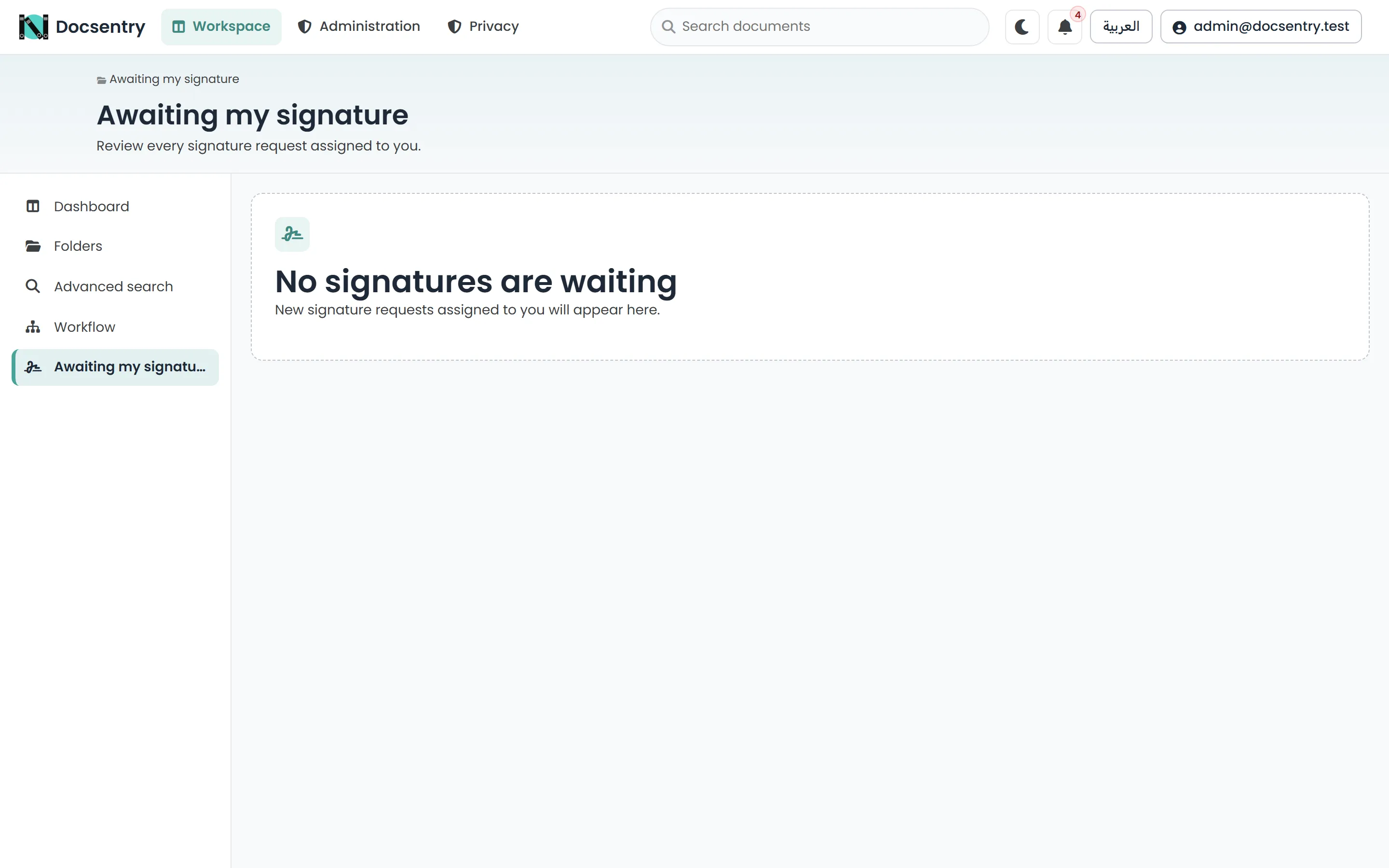
Signature requests waiting on you appear under Awaiting my signature.
Use the signing studio
Section titled “Use the signing studio”Open a pending request to enter the signing studio. The page shows the requested document version and page navigation alongside a drawing canvas.
- Move to the page that should carry the signature.
- Draw your signature in the canvas. Use Clear if you need to start again.
- Select Place, then position the signature on the document page.
- Resize the placement to the required width and height.
- Confirm the signature.
The submitted record includes the page number and normalized placement rectangle. Only the named signer can complete the request. If the request is no longer pending, the version changed, signing was disabled, or the signing base is unavailable, Docsentry refuses the submission rather than applying it to a different state.
Decline or withdraw a request
Section titled “Decline or withdraw a request”The signer can decline a pending request and may include a reason of up to 1,000 characters. The requester is notified of the outcome.
A user with Manage workflow can withdraw a pending or already signed request from the document’s signature panel. The interface labels this action Withdraw; the stored status is revoked. Declined, revoked, and expired requests remain visible as history but cannot be signed.
Rendition and certificate
Section titled “Rendition and certificate”For the current version, the signature panel lists requests and their state. When the version has applied signatures, you can download:
- Signed rendition: a PDF composed from the signing base with the captured ink placed on the recorded pages.
- Signature certificate: a PDF record containing the signer, signing time, page, placement, the SHA-256 content fingerprint captured at signing, and the verification result.
If an earlier version was signed but the current version is not, the panel says so. Signatures belong to a version; uploading or restoring content does not silently move them to another version.
What verification proves
Section titled “What verification proves”For each signed signature, Docsentry compares the SHA-256 fingerprint stored on the signature with the fingerprint currently recorded for the physical file referenced by that document version. A match means the version is still bound to the fingerprint captured at signing. A mismatch means the version now points to content with a different recorded fingerprint.
Treat the feature as handwritten-signature capture plus database-level tamper evidence. If your process requires certificate-backed digital signatures, identity proofing, or legal non-repudiation, provide those controls outside this feature.