
Users and roles
User administration is under Users and Roles in the administration section.
Creating a user
Section titled “Creating a user”Self-registration is disabled by default, so accounts are created by an administrator from the Users screen. You supply the account details; the new user completes their own password setup rather than being handed one.
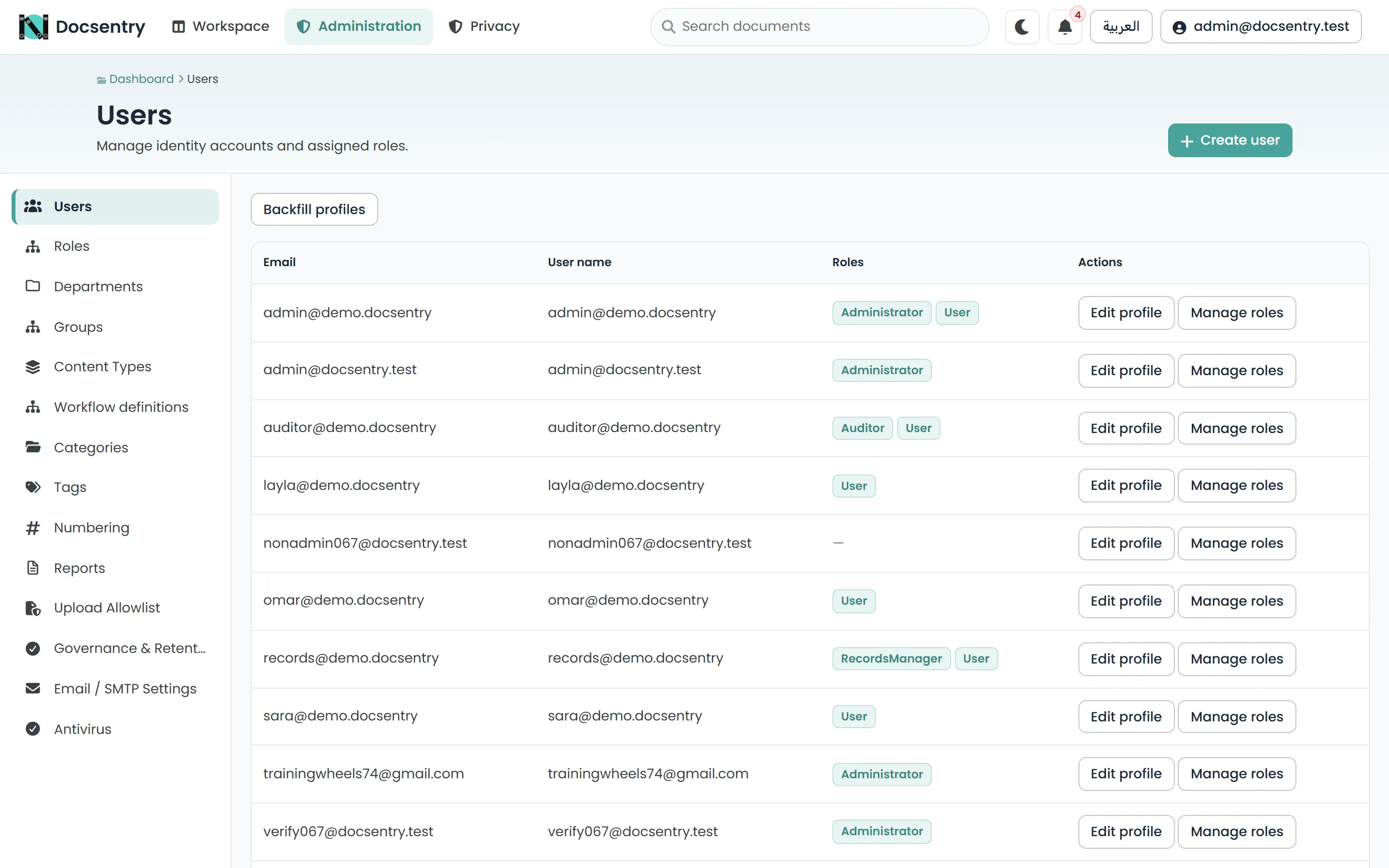
The Users screen. Accounts are created here; roles are assigned per account.
System roles
Section titled “System roles”Five roles are seeded with the schema and cannot be removed:
| Role | Grants access to |
|---|---|
Administrator |
Every administrative screen, including users, roles, and configuration. |
RecordsManager |
Records lifecycle: retention, governance, repository-wide document management. |
WorkflowManager |
Authoring and managing workflow definitions. |
Auditor |
Audit and reporting surfaces, read-only. |
User |
Ordinary workspace use. |
Authorisation policies are built on these, plus a MetadataConfiguration policy that gates the
content type, taxonomy, and numbering screens.
Custom roles can be created alongside the system ones, renamed, and deleted. Membership is managed from each role’s members screen.
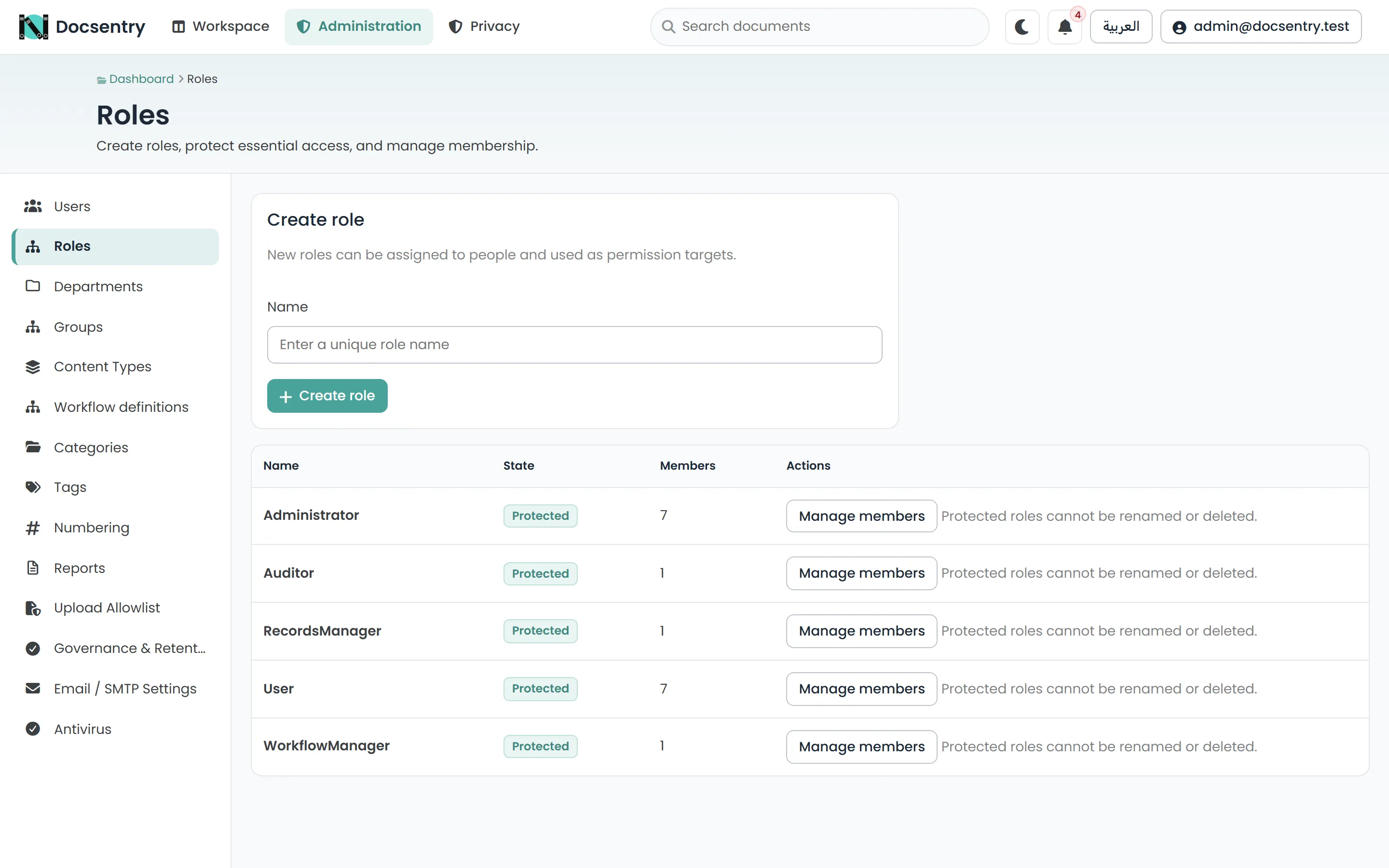
Roles and their membership. Custom roles sit alongside the five seeded system roles.
Choosing roles
Section titled “Choosing roles”Give Administrator to as few people as the organisation can tolerate. The three specialised
roles exist so that the common reasons for needing elevated access - managing records, authoring
workflows, reviewing audit trails - do not each require full administrative control.
Auditor is the one most often overlooked. Someone who needs to review the audit log does not
need the ability to modify the repository.
User profiles
Section titled “User profiles”Profiles hold the descriptive information attached to an account: display details, department, and organisation unit membership. Department and organisation unit membership is what makes group-based access grants work, so it is worth keeping accurate - see Departments and org units.
A backfill action exists to provision profiles for accounts that predate the profile feature or were created outside the normal flow. Run it once after an import rather than editing each account.
Account security
Section titled “Account security”| Setting | Default | Effect |
|---|---|---|
AccountSecurity:MaxFailedAccessAttempts |
5 | Failed sign-ins before lockout. |
AccountSecurity:LockoutMinutes |
15 | Lockout duration. |
AccountSecurity:AllowSelfRegistration |
false |
Anonymous account creation. |
Passwords require at least eight characters with upper case, lower case, and a digit. Email addresses are unique across accounts.
Two-factor authentication is available to every user through their own profile, using an authenticator app with recovery codes. It is not enforced centrally, so for administrator accounts it is worth confirming rather than assuming - the security health report lists accounts without it. See Reports.
When someone leaves
Section titled “When someone leaves”Deactivating an account stops the person signing in, but leaves work attached to them. Two things need attention:
- Workflow tasks. A reconciliation job reassigns tasks belonging to a departed user, so they do not sit in an inbox nobody opens. Confirm the job is enabled - see Background jobs.
- Access-control entries naming them individually. Group-based grants resolve themselves when membership changes; entries naming the individual do not. This is the strongest practical argument for granting to departments and roles rather than to people.
Related
Section titled “Related”- Permission model - what actually decides access.
- Departments and org units - grouping people.
- Security hardening - authentication configuration in full.