
Numbering schemes
A numbering scheme produces formal document identifiers - INV-2026-0042, CTR/26/0007.
Schemes are defined under Numbering in the administration section.
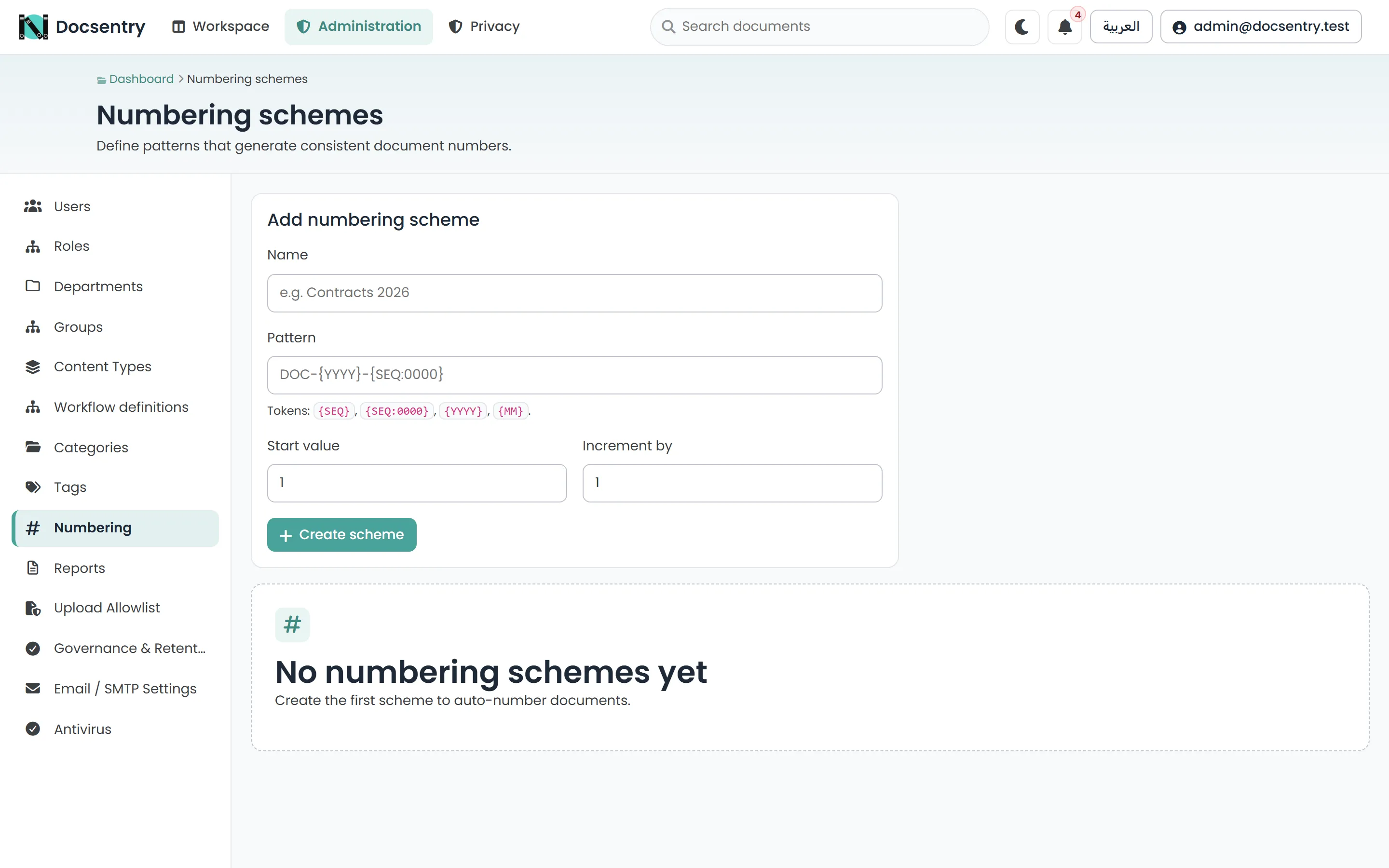
Numbering schemes and their patterns. Sequence values are allocated server-side.
Patterns
Section titled “Patterns”A scheme’s pattern is a template built from tokens:
| Token | Expands to |
|---|---|
{YYYY} |
Four-digit year, e.g. 2026. |
{YY} |
Two-digit year, e.g. 26. |
{MM} |
Two-digit month, e.g. 03. |
{SEQ} |
The allocated sequence value, unpadded. |
{SEQ:0000} |
The sequence value, zero-padded to the given number of digits. |
Anything else in the pattern is literal.
Examples
Section titled “Examples”| Pattern | Produces |
|---|---|
INV-{YYYY}-{SEQ:0000} |
INV-2026-0042 |
CTR/{YY}/{SEQ:0000} |
CTR/26/0007 |
{YYYY}{MM}-{SEQ:000} |
202603-014 |
{SEQ:0000} |
0042 |
{SEQ:0000} is the default when no pattern is given.
The sequence is always included
Section titled “The sequence is always included”If a pattern contains no {SEQ} token at all, the allocated value is appended anyway, padded to
four digits, with a separator inserted unless the pattern already ends in - or /.
A pattern of INV-{YYYY} therefore yields INV-2026-0042, not INV-2026 repeated. A scheme
cannot be configured into producing the same identifier twice.
Allocation
Section titled “Allocation”Numbers are allocated server-side, in the database. Two people numbering documents at the same instant receive different numbers; there is no client-side counter to drift or collide.
Allocation is a deliberate act: a number is issued when it is requested, not automatically on every upload. This is what you want - a formal identifier should be assigned when a document becomes the thing that needs one, not to every draft that passes through.
Padding
Section titled “Padding”Choose padding for the volume you expect over the scheme’s life, not this year’s. {SEQ:000}
allows 999 before the format grows a digit, and identifiers that change shape partway through a
series sort badly and read as a mistake.
Four digits is a reasonable default. Six is not excessive for a high-volume scheme.
Year and month tokens
Section titled “Year and month tokens”{YYYY} and {MM} expand from the allocation time, so a number issued in March 2026 carries
2026 and 03.
Note that the tokens format the date but do not reset the sequence. If you want a series that
restarts each year, that is a matter of how you manage schemes, not something the pattern does on
its own. A pattern containing {YYYY} with a continuously increasing sequence produces
INV-2026-0042 followed by INV-2027-0043, which is valid but may not be what was intended.
Editing a scheme
Section titled “Editing a scheme”Changing a pattern affects numbers allocated from then on. Already-issued numbers are recorded on their documents and do not change - which is correct, because an identifier that changes retroactively is not an identifier.
Expect a scheme’s history to contain more than one format if it has been edited. That is a reason to settle the pattern before the scheme goes into use.
Related
Section titled “Related”- Metadata and content types - numbering in the context of the other classification mechanisms.
- Content types and taxonomy - the neighbouring administrative screens.