
Email is configured under Governance > Email / SMTP Settings in the administration section, and by
the Email and EmailIntake configuration sections.
Outbound email
Section titled “Outbound email”| Setting | Default | Purpose |
|---|---|---|
Email:Enabled |
false |
Master switch. Off means nothing is sent. |
Email:Host |
- | SMTP host. |
Email:Port |
587 |
SMTP port. |
Email:UseStartTls |
true |
Upgrade the connection with STARTTLS. |
Email:Username |
- | SMTP username. |
Email:Password |
- | SMTP password. |
Email:ApiKey |
- | API key, where the provider uses one instead of a password. |
Email:FromAddress |
- | Sender address on outgoing mail. |
Email is disabled by default. In-app notifications still work; only delivery by mail is withheld. This is a reasonable state for a development or internal deployment.
The settings screen includes a test send, which is worth using before assuming the configuration is right. Silent non-delivery is otherwise easy to miss for weeks.
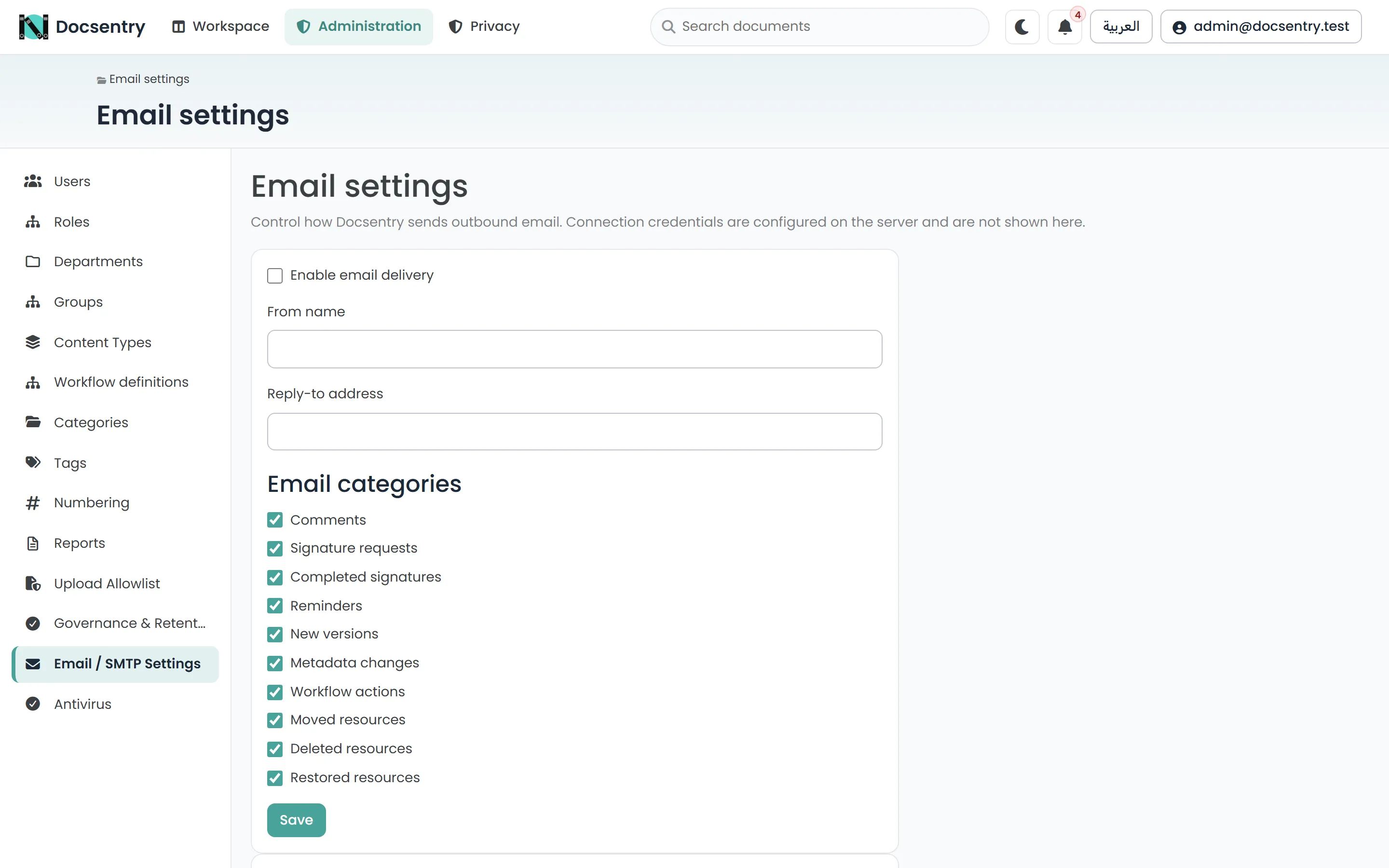
SMTP settings, with a test send. Use it before assuming delivery works.
The outbox
Section titled “The outbox”Mail is not sent during the request that triggers it. It is written to a durable outbox and delivered by a background job.
| Setting | Default | Purpose |
|---|---|---|
BackgroundJobs:EmailDelivery:Interval |
1 minute | How often the outbox is drained. |
BackgroundJobs:EmailDelivery:MaxItems |
100 | Messages per pass. |
BackgroundJobs:EmailDelivery:MaxAttempts |
3 | Attempts before a message is given up on. |
BackgroundJobs:EmailDelivery:BaseBackoff |
1 minute | Delay before a retry, growing with each attempt. |
BackgroundJobs:EmailDelivery:LeaseTimeout |
5 minutes | How long a claimed message stays claimed. |
This design has three consequences worth knowing:
- A slow or unreachable mail server does not slow the application. The user’s action completes; delivery catches up.
- Transient failures resolve themselves. A mail server down for two minutes causes a retry, not a lost notification.
- The lease means a crashed delivery pass does not strand messages. A claim that is not completed within the lease timeout is reclaimed by the next pass.
Delivery is therefore near-real-time rather than instant. A notification arriving a minute after the event is working as designed.
Notification preferences
Section titled “Notification preferences”Each user controls which notifications reach them by email, from their own email preferences page. Categories cover the events the system raises - workflow assignments, signature requests, reminders, comments, and similar.
In-app notifications are not affected by these preferences. Turning off an email category stops the mail, not the notification bell.
Sensible defaults matter here: notifications that are individually reasonable become noise in aggregate, and a user who mutes everything because the volume was intolerable will also miss the one that mattered.
Templates
Section titled “Templates”Mail is rendered from templates in both English and Arabic. A recipient receives mail in their own language, resolved from their culture rather than from the sender’s.
Adding or changing a template means providing both languages. See Localization.
Inbound folder email intake
Section titled “Inbound folder email intake”Docsentry can also poll a mailbox and file incoming attachments into a folder.
| Setting | Default | Purpose |
|---|---|---|
EmailIntake:Enabled |
false |
Master switch. |
EmailIntake:Host |
- | IMAP host. |
EmailIntake:Port |
993 |
IMAP port. |
EmailIntake:UseSsl |
true |
Use SSL. |
EmailIntake:Username |
- | Mailbox username. |
EmailIntake:Password |
- | Mailbox password. |
EmailIntake:MailboxFolder |
INBOX |
Which mailbox folder to read. |
EmailIntake:BatchSize |
50 |
Messages per pass. |
Intake is disabled by default, and its background job is likewise disabled by default. Both must be turned on.
Related
Section titled “Related”- Collaboration - what generates notifications.
- Background jobs - the delivery and intake jobs.
- Localization - bilingual templates.